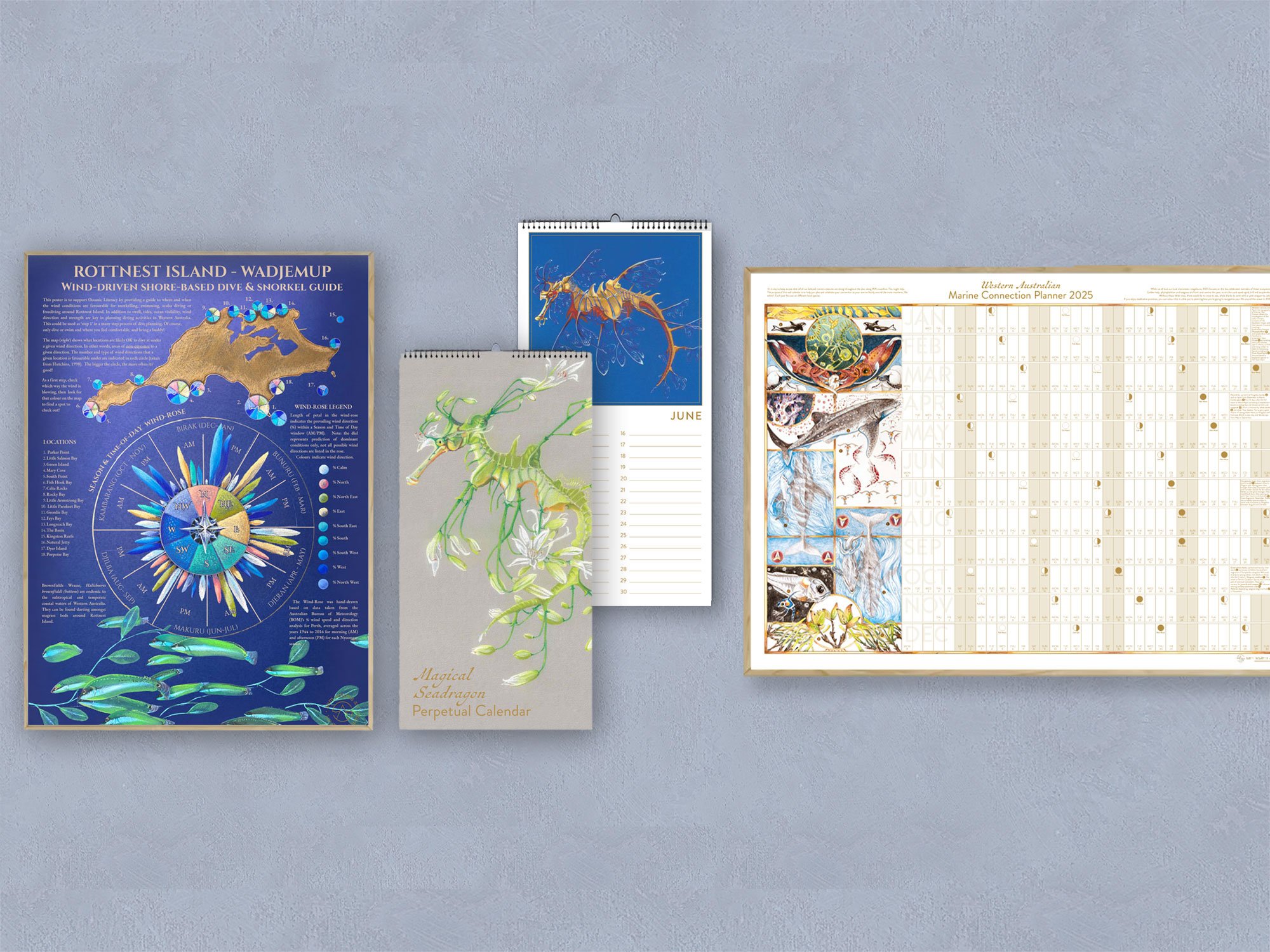
MARINE CONNECTION PLANNERS

Welcome to the domain of marine psychology - Connecting people to the Sea through Art for the wellbeing of both.
As a marine biologist, I’m invested in inspiring as many people as possible to love our marine world. Science communication is one way to do this, and is what this page is all about. Art is a far more effective science communication tool than the more traditional words and graphs (the data says so!). The process of making art is also a connective medium - it improves cognition, memory and general wellbeing. Draw a sketch of a scene on your travels, and you will remember that time and place with greater clarity, emotional content and for longer than if you didn’t (no matter how good the drawing is). People feel better when they connect to Nature and are more inclined to protect what they know and love. Connecting to the Sea can be a sacred practice for some, and it’s important to know what our beloved marine family is doing during the year as part of this practice. For others, maybe just a beautiful marine creature to remind you of important anniversaries, events and birthdays is enough. Either way, these Marine Connection Planners are here to help.
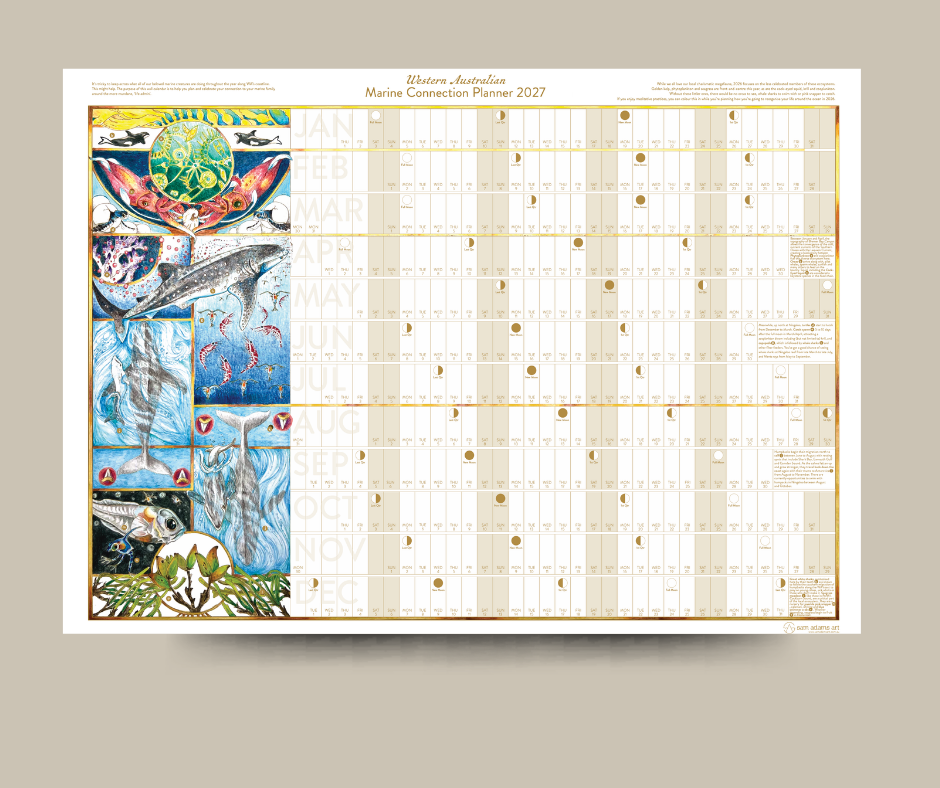
Marine Connection Planner 2027
***pre-order now!***
It’s tricky to keep across what all of our beloved marine creatures are doing through the year along WA’s coastline. This might help.
The purpose of this wall calendar is to help you plan and celebrate your connection to your marine family around the more mundane, ‘life admin’.
While we all love our local charismatic megafauna, this planner focuses on the less celebrated, but critical, members of these ecosystems. Golden kelp, phytoplankton, and seagrass are front-and-centre, as are the cock-eyed squid and zooplankton. Without these littler ones, there would be no orcas to see, whalesharks to swim with, or pink snapper to catch.
If you enjoy meditative practices, there is a version of this planner that you can colour in! Just email Sam at info@samadamsart.com.au if you’d like this version.
These planners are A2 size, printed on high quality mat 160gsm paper that is a pleasure to write on.
Magical Seadragon - Perpetual Calendar
As a marine biologist, I loved the field of vicariance biogeography. Vicariance is the physical division of organisms based on environmental change. Studying this at a time before the advanced genetic technologies we have today, some imagination was required (at times) to align variation in morphology with historical shifts in geography.
One day in 2003 I was struck by the question of what a seadragon might look like if it lived in Antarctica. I imagined that it would have snowflakes for fins and have the delicate transparency of plankton. This idea led to a scientific line of enquiry of all the new magical seadragon species that are yet to be discovered in a range of locations, from coral reefs, including our own Ningaloo, the Deep Sea as well as our own back yards of imagination. They live alongside those that we know exist and love today, showing how they’re just as magical as those you might see in a fairytale.

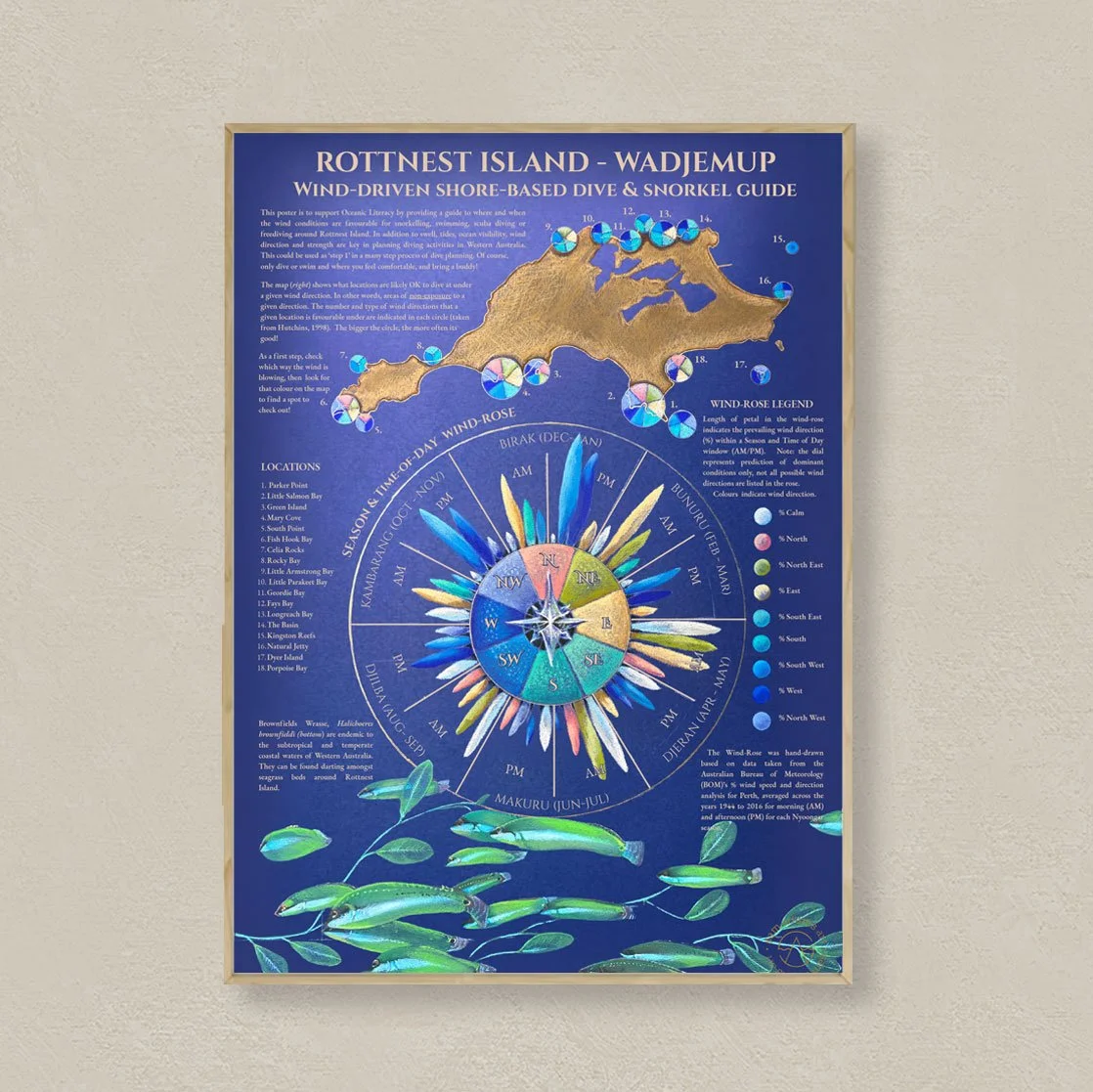
Rottnest Island Wind-Driven Freediving & Snorkelling Guide
Type ‘where can I go snorkelling at Rottnest Island’ into google and you’ll find it a common question, but it doesn’t have a straightforward answer. It often depends on which way the wind is blowing interacting with the unique geography of Wadjemup - Rottnest Island. Weather apps alone can’t answer this one, but this poster might help.
The Rottnest map draws on the fantastic work of Dr Barry Hutchins in his (1998) Snorkeller’s Guide to Rottnest (Swainston Publishing), showing you what locations are likely ‘OK’ under moderate to fresh winds of a given direction. Below this is a hand-drawn wind-rose of the dominant winds in the morning and afternoon for each Noongar season, including when it’s calm – taking from over 70 years of BOM wind data. Here you’ll have a sense of what to expect, and when. And of course, my favourite wrasse, who you’ll find darting amongst the seagrass beds.
Excluding the text, all elements in this poster were hand-drawn using pastel pencils and metallic copper ink on blue pastel paper. The colours chosen reflect those of Wadjemup land and sea country; pink of the salt lakes, mauve for the purple wildflowers, the salty-green of the island vegetation, soft yellow for the limestone, and the beautiful aqua and blue shades of the surrounding Indian Ocean.
Size: A2 (42 cm by 59.4cm) - printed on 180gsm high quality gloss stock - makes for a colourful addition to your wall.